It was a Tuesday morning when the frantic phone call came in. ‘Mark, we’re gone! The shop isn’t on the map anymore!’ My heart sank. A week earlier, I’d helped a local bakery client set their profile to ‘Permanently Closed’ because they were moving two blocks over and I thought it would stop people from showing up at the old, empty storefront. I was wrong. Dead wrong. I didn’t just hide the old address; I effectively told Google to delete years of hard-earned authority and reputation. Within forty-eight hours, their map pin got stuck in digital limbo, and their traffic flatlined. I learned the hard way that Google treats ‘Permanent’ and ‘Temporary’ not as suggestions, but as life-and-death commands for your visibility. [image-placeholder]
The Day I Accidentally Deleted a Client from the Local Pack
I once made the rookie mistake of thinking Google’s algorithm would just ‘figure it out’ if I swapped the status back and forth. I thought the system was smart enough to know a renovation didn’t mean the business was dead. It wasn’t. By the time I realized my error, we were staring at a sudden drop in Google Maps traffic that took nearly three months to repair. This experience taught me that the toggle you choose in your dashboard is a powerful signal. ‘Permanently Closed’ is a kill switch. ‘Temporarily Closed’ is a pause button. If you use the wrong one, you’re not just losing customers for the week; your closed status is costing you permanent customer trust and search equity. Today, I’m going to show you exactly how to navigate these settings so you never have to feel that pit in your stomach like I did.
Is the risk of a temporary closure actually worth the hassle?
Many business owners fear that even a temporary tag will scare away leads forever. However, according to Google Business Profile documentation, marking a location as permanently closed can lead to the immediate loss of all ranking signals associated with that specific CID, making recovery a mountain-climbing exercise. In contrast, the ‘Temporary’ tag preserves your rank but adjusts your visibility for ‘open now’ searches. Have you ever seen your business vanish from the map after a holiday or a quick renovation break? It’s a common nightmare, but there is a simple fix for a vanishing Google Maps business profile if you act fast. We are going to dive into the data signals that actually move the needle when you need to bring a ‘paused’ business back to the top of the pack.
Stop Treating the Close Button Like a Light Switch
When a business has to shut its doors for a renovation or a unexpected emergency, the instinct is often to flip the ‘Permanently Closed’ switch to stop the phone from ringing. Don’t do it. Think of your Google Business Profile like a massive flywheel; it takes months to get it spinning at full speed. When you mark a business as permanently closed, you’re basically throwing a metal rod into the gears. I remember a plumbing client whose own office flooded—talk about irony. They were ready to wipe their profile clean to ‘start fresh’ after the repairs. We stopped them and ran the no-fluff checklist for auditing your local listings fast to ensure their citations remained consistent while they were technically offline.
Keep Your Site Working While the Doors Are Locked
Even if your physical location is dark, your digital presence should be louder than ever. This is the time to refine your landing pages. If you know how to structure your service pages for a map boost correctly, Google continues to crawl your site for relevance, even if your map pin is temporarily hidden from ‘open now’ queries. We kept that plumber’s service pages updated with ’24/7 emergency’ keywords even while their main office was drying out. This maintained their authority so they didn’t have to start from zero when the doors reopened.
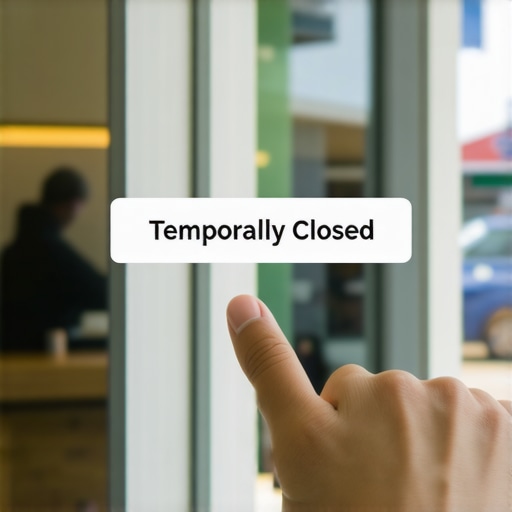
Why Your Rank Disappears When You Lock Up
Google prioritizes the user experience above all else. If someone searches for a service at 10 PM and you’re closed, Google won’t show you. It’s why why your map ranking vanishes after 5 pm and how to fix it is such a common concern for local business owners. When you select ‘Temporarily Closed’, you are telling the algorithm, ‘I’m still here, I’m just not available for a transaction right now.’ This preserves your historical data, your reviews, and your local trust score without tricking customers.
Prove You are Back with Better Data
The moment you flip that switch back to ‘Open,’ you need to flood the system with fresh signals. Google is naturally skeptical. It needs proof that you’re actually standing behind the counter again. This is where the specific image metadata we use to prove location authority to google becomes your best friend. I had that plumber take a photo of their new office flooring with their smartphone, making sure the GPS coordinates were embedded. We uploaded that immediately upon reopening. Within 24 hours, their map pin wasn’t just back; it was higher than before because of the fresh activity burst.
Build Brand Trust While You Rebuild
Don’t forget that Google looks far beyond your dashboard. The relationship between brand mentions and map authority is incredibly strong. While you’re closed, try to get a local news mention or a shout-out from a local community group about your ‘Grand Reopening.’ These digital breadcrumbs tell Google that you are a living, breathing part of the community, making it much harder for the algorithm to suppress your profile when you return to active status.
Stop Obsessing Over Your Business Description
Everyone tells you to spend hours perfecting that 750-character business description, carefully weaving in every service you offer. Here is the cold, hard truth: why your google business profile description matters less than you think comes down to the algorithm’s priorities. Google barely uses that field for ranking. It’s for the humans, not the robots. While you’re busy tweaking adjectives, your competitor is likely focusing on behavioral signals that actually move the needle. In my experience, a profile with a mediocre description but a high engagement rate will crush a ‘perfect’ profile every time because why your maps engagement rate matters more than raw traffic is the real secret behind long-term stability.
Why do competitors with half your reviews still rank higher?
It’s the most common frustration in local SEO. You have 200 five-star reviews, yet a guy down the street with 45 reviews is sitting in the top spot. According to the BrightLocal Local Search Ranking Factors study, review velocity and diversity often outweigh the raw total. If those 45 reviews are coming in steadily and include the impact of user-uploaded videos on your local ranking authority, Google sees a ‘hot’ business. A profile that got 150 reviews three years ago and has been silent since looks stagnant. This is why your competitor with fewer reviews is outranking you; they are proving their current relevance while you are resting on historical laurels.
Don’t Let a Virtual Office Kill Your Credibility
In a rush to expand, many business owners try to ‘hack’ the system by renting a virtual office or a co-working space to capture a new neighborhood. This is a massive ‘oops’ factor that leads to immediate suspension. Google’s AI is incredibly sophisticated at flagging addresses associated with mail-forwarding services. If you aren’t careful, even the tiny error in your suite number that blocks your local pack entry can trigger a manual review. I always tell my clients that the problem with using a virtual office address for local seo isn’t just about the initial setup; it’s the fact that you have no real-world ‘signals’ like Wi-Fi pings or customer GPS data to back up your existence.
Your Secondary Categories Might Be Sabotaging You
Another nuance most people miss is ‘category dilution.’ You think that by adding every possible category related to your business, you’re widening the net. You’re actually poking holes in it. If you are a high-end Italian restaurant but you also add ‘Pizza Takeaway’ and ‘Event Venue,’ you might find your main ranking for ‘Italian Restaurant’ starts to slip. This happens because why your secondary categories might be diluting your primary rank is a real algorithmic weight. Google wants to provide the most specific answer to a user’s query, and if your profile is a ‘jack of all trades,’ you are the master of none. Have you ever fallen into this trap of over-optimizing and seen your rankings actually drop? Let me know in the comments. I’ve found that stripping back to one primary and two highly relevant secondary categories often triggers a rank boost within 48 hours.
The 15-Minute Habit That Keeps Your Pin Glued to the Top
I’ve spent thousands of dollars on tools that promised to ‘automate’ my way to the number one spot, but honestly? Nothing beats a manual check-in. Every Monday morning, I run the 15-minute audit routine for finding hidden visibility gaps. I don’t look at the big numbers; I look for ‘ghost changes’—those little suggested edits from ‘the community’ that Google silently accepts. Sometimes it’s a slight shift in your map pin or an updated phone number that isn’t quite right. If you aren’t performing the one daily task to keep your map pin glued to the top spot, you’re leaving your digital storefront open to vandalism. This isn’t just about maintenance; it’s about defending your territory from competitors who are constantly testing the fences.
How do I keep my map ranking high month after month?
Maintenance isn’t a one-and-done project. I recommend focusing on ‘review velocity’ rather than volume. A steady stream of three reviews per week is infinitely better than getting fifty in one day and then going silent for six months. When those reviews come in, keep your eyes on the engagement metrics. I’ve noticed that why your maps engagement rate matters more than raw traffic is becoming the dominant signal. Google wants to see people clicking ‘Call,’ asking for directions, and actually spending time on your profile. If your listing is a ghost town, your ranking will eventually reflect that lack of life.
Don’t Fall for the Cheap Citation Trap
As you scale, you’ll be tempted to hire a service that promises a thousand citations for fifty bucks. Stop right there. I’ve seen more profiles tanked by messy data than by lack of backlinks. Understanding the real cost of cheap citation building for your long-term map rank is vital. When your address is listed as ‘Suite 201’ in one place and ‘Unit 201’ in fifty others, it creates a trust gap in Google’s brain. We spend hours cleaning up the messy citation errors most local businesses overlook because a clean, 100% consistent footprint is what actually signals authority. 
Scaling Your Map Presence Without Getting Banned
If you’re opening a second or third location, the rules of the game change. You can’t just copy-paste your strategy. I see people get their entire account suspended because they don’t know how to manage multiple business locations without creating search conflicts. Each location needs its own unique landing page with hyper-local content. You need to learn how to scale local content across multiple locations easily by focusing on what makes that specific neighborhood unique, rather than just changing the city name in the footer. Also, skip the software that ‘automates’ your photo geotagging; why manually geotagging your profile photos is a waste of time has been proven repeatedly by local experts like Joy Hawkins at Sterling Sky, who noted that Google’s AI is smart enough to know where a photo was taken without you faking the EXIF data.
Where Local Search is Heading Next
The future of the 3-pack is going to be dominated by ‘Zero-Click’ conversions. Google wants to answer every question right there on the search results page. This means the content tweak for service pages that actually moves your map pin is no longer about just keywords, but about providing immediate utility. We are seeing a massive shift where ‘real-world’ signals—like how long people stay at your shop and how many people actually use their GPS to find you—outweigh traditional SEO factors. Try this today: Go into your dashboard and remove any secondary category that isn’t 100% relevant to your core business. You might just see why your primary category selection is likely sabotaging your search rank and get a quick boost just by narrowing your focus.
The Hardest Lessons from My Most Stressful Map Suspensions
After years of managing profiles, the one truth that stands out is that Google values stability over speed. I’ve seen many businesses attempt to rank 3 pack listings overnight by spamming categories, only to find themselves invisible the next morning. My personal lightbulb moment came when I realized that local pack optimization isn’t a checklist you complete once; it’s a constant conversation you have with your community. When you focus on why your maps engagement rate matters more than raw traffic, you build a profile that can survive algorithm updates. Remember, a single verified address is worth more than ten virtual office addresses that risk your entire digital existence.
- Consistency beats intensity every time—stop the review blasts and aim for a steady pulse of activity.
- Your physical presence is your greatest asset; don’t hide it behind layers of automation.
- Don’t wait for a crisis; run the 15-minute audit routine for finding hidden visibility gaps every Monday to stay ahead of malicious suggested edits.
- Authenticity wins—user-generated content like the impact of user-uploaded videos on your local ranking authority provides social proof that no bot can fake.
[image-placeholder]
The Essential Gear for Consistent Local Rankings
To get a google maps boost that actually sticks, you need tools that prioritize data cleanliness over raw volume. I personally swear by Whitespark for auditing because they help identify the messy citation errors most local businesses overlook before they become a ranking anchor. I also keep the BrightLocal ‘Local Search Ranking Factors’ study bookmarked as my north star. These aren’t just tools; they are the foundation for anyone looking to improve local pack presence without falling into the trap of cheap, automated services that do more harm than good.
Time to Take Back Your Map Authority
You’ve seen the pitfalls and the blueprints for success. Now, it’s time to act. Your business deserves to be the first thing customers see when they search for help in your area. Start by implementing 5 specific profile changes that trigger a rank boost within 48 hours. This journey to boost 3 pack rankings is a marathon, but the rewards are a steady stream of calls and customers who trust you before they even dial. Have you ever felt that sudden panic when your map pin wasn’t where it belonged? Let me know in the comments below!