I remember sitting at my kitchen table at 2 AM, staring at my laptop screen until my eyes burned. I was doing everything right for my local shop, or so I thought. My photos were crisp, my hours were set, and I was begging every customer for a review. Yet, there was this one competitor—a guy whose office was half the size of mine and whose website looked like it was built in 1998—consistently sitting at the top of the Google Maps 3-pack. It felt like he knew a secret I didn’t. I was stuck on page two, and if you’ve ever been there, you know it’s basically the digital graveyard. I made a huge mistake early on by thinking I could just blast my business name across every generic directory on the internet. I bought a package of 500 citations from a random site, and all it did was create a mess I had to clean up later. What I didn’t realize back then was that it’s not about how many citations you have; it’s about the quality and relevance of the ones your competitors have that you don’t. Today, I’m going to show you exactly how to stop guessing and start seeing the specific links that are giving your rivals an unfair advantage.
Stop Guessing and Start Seeing Where Your Rivals Are Hiding
If you want to fix a map ranking that is stuck on page two, you have to realize that Google is essentially a popularity contest based on trust. When your competitor shows up in the 3-pack, it’s often because they have niche-specific citations that move the needle. They might be listed on a local neighborhood blog or a trade-specific directory that you haven’t even heard of yet. According to data from Whitespark, citation signals still play a significant role in how Google validates the physical existence and prominence of a local business. By using the right tools to spy on local competitors, you can find these hidden gems and claim them for yourself. Have you ever felt like you’re playing a rigged game against a competitor who seems to rank effortlessly despite having a worse website than yours?
Is hunting for hidden citations actually worth the effort?
The short answer is yes, but only if you focus on the ones that actually carry weight. You don’t need a thousand links; you need the ten links that your top three competitors all share. This is about efficiency. We’re going to look at the tools that help you identify those gaps so you can stop wasting time on directories that don’t matter. If you’ve been struggling with inconsistent data, you might also need to learn how to purge old citations that are confusing Google and holding your rank back. Let’s dive into the three tools that changed the game for me and finally got my pin to stay where it belongs.
The Simple Math of Outpacing the Local 3-Pack
To win the map game, you have to think like a private investigator. Google isn’t just looking at your website; it’s looking for corroborating evidence across the entire web. Think of every citation as a witness testifying that your business is exactly where you say it is. If your competitors are outranking you, it’s because they have more credible witnesses in their corner. You need to use the 5 tools we use to spy on local competitors to pull back the curtain. When I first started doing this for a local locksmith, I was shocked. We found that the top-ranked guy wasn’t just on Yelp; he had a link from a local neighborhood watch blog and a small-town hardware association. Those two links alone were doing more heavy lifting than 200 generic directories. This is why your competitors are outranking you for niche services even if their websites look like relics from the 90s.
Find the Gaps Before You Build the Links
Don’t just start submitting your info to every site you find. That’s a recipe for a data nightmare. Instead, look for the ‘overlap.’ If your top three competitors are all listed on a specific local chamber of commerce site or a niche trade directory, that is your primary target. This is about identifying the specific authority signals that Google has already decided it likes for your specific city and industry. I once spent three sleepless nights trying to figure out why a client’s HVAC business wouldn’t budge from spot #4. It turned out their business name was listed slightly differently on a local utility directory—a tiny detail that was eroding trust. Fixing the ranking impact of having a consistent business name is often the fastest way to see a jump in visibility.
Why Your Storefront Photo Beats Your Logo Every Time
Google is obsessed with physical proof. While citations provide the text-based proof, your photos provide the visual confirmation. I’ve seen businesses jump two spots just by swapping their brand logo for a high-resolution shot of their actual front door. Why? Because it proves to Google—and more importantly, to the user—that you aren’t a ghost kitchen or a virtual office. In fact, why your store entrance photo is more important than your logo comes down to trust. I once worked with a legal firm that insisted on using a stock image of a gavel as their main photo. They were invisible on maps. Within a week of uploading a photo of their actual office building with their sign clearly visible, their impressions doubled. You should also be careful about your reach; I often see businesses fail because they try to cover too much ground. Understanding why your service area radius should be smaller not larger can prevent Google from diluting your local authority. Stick to the areas where you can actually prove your physical presence through local links and customer interactions.Everyone tells you that reviews are the end-all-be-all of local SEO. If you just get more five-star ratings, you’ll win, right? In my experience, that is a dangerous oversimplification. I’ve seen businesses with 500 reviews get smoked by a competitor with 50 because the latter had better alignment with search intent. The real needle-mover that people overlook is the data hidden deep in your dashboard. For instance, the ranking boost from using specific service attributes can often outweigh a dozen generic reviews. If Google knows you offer ’emergency repair’ or ‘senior discounts’ because you’ve checked those boxes, you’ll show up for those high-intent queries while your review-heavy competitor stays hidden.
Why does your map pin disappear when you zoom out?
This is one of the most frustrating things for a business owner to witness. You’re sitting at your desk, you search for your service, and there you are. But move the map two inches or zoom out, and poof—you’re gone. This usually happens because of a lack of ‘local prominence’ or an overly broad service area. According to a study by Sterling Sky, the proximity of the searcher to the business is the single most powerful ranking factor, but it is heavily influenced by how well you’ve defined your territory. If you’ve fallen into the problem with having too many service area cities, Google effectively gets confused about where your ‘true’ home base is. This dilution of authority is a silent killer for your visibility. 
The Service Area Trap That Kills Your Authority
The ‘Oops’ factor I see most often is what I call the ‘Greed Radius.’ Business owners think that by selecting every city within a 50-mile radius, they are casting a wider net. In reality, you are just poking holes in your own boat. Google’s algorithm is designed to surface the most relevant *local* result. When you claim to serve a massive area without the physical proof to back it up—like local check-ins or neighborhood-specific reviews—Google simply stops trusting your pin. This is why your service area radius should be smaller not larger if you actually want to dominate the 3-pack. You are much better off being the undisputed king of a 5-mile radius than being ‘maybe’ relevant in a 50-mile one. Have you ever fallen into this trap of trying to cover too much ground? Let me know in the comments.
Small Tweaks with Massive Ranking Implications
If you really want to fix a map ranking that is stuck on page two, look at your ‘Services’ menu. Most people leave this blank or let Google auto-populate it. That is a massive mistake. There is a the hidden ranking signal in your services menu that helps Google categorize your business for specific long-tail searches. Similarly, your hours of operation play a bigger role than you think. There is a massive the ranking difference between open now and 24 hours when a user filters for immediate help. If your competitors are listed as ‘Open 24/7’ and you close at 5 PM, they will jump over you every single evening, regardless of how many citations you have. Stop focusing on the vanity metrics and start looking at the granular data points that prove your relevance to the local community every single hour of the day.Maintaining your spot in the 3-pack isn’t a ‘set it and forget it’ situation. I’ve seen businesses climb to the top through sheer effort only to vanish a month later because they stopped paying attention to the signals. One of the biggest secrets is activity velocity. If you want to stay visible, you need to realize why your profile needs to be updated every 7 days. Google’s algorithm isn’t just looking at who you are; it’s looking at how active you are today. If you stop posting, stop getting reviews, or stop adding photos, your ‘freshness’ score starts to decay, allowing a hungrier competitor to slide into your spot. I personally use a tool called Local Falcon to run weekly heatmaps. Unlike static reports, heatmaps show you exactly where your rank drops off street by street, which is essential for the secret to ranking for near me searches in suburbia. According to BrightLocal’s recent Local Search Rankings study, proximity remains a heavy hitter, but sustained activity is what prevents your pin from being pushed out by newer listings.
How do I maintain my 3-pack rank over time?
Consistency is more important than intensity. Instead of spending five hours once a month, spend fifteen minutes every Monday morning. Check your Q&A section, because the hidden power of responding to the questions section can actually trigger ranking boosts for specific keywords users are asking about. Then, upload one or two new photos. I’m a huge advocate for seasonal changes; why your profile needs fresh exterior shots every season isn’t just about aesthetics—it’s about proving to Google that you are still physically operational and relevant. 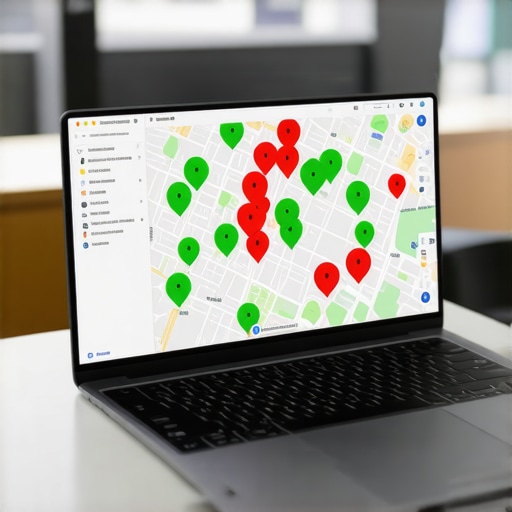
Tools that actually show you the truth about your ranking
If you are still just searching for your business on your own phone while standing in your office, you are getting a biased result. You need to see the ‘real’ map. I rely on tools that simulate searches from different GPS coordinates. This helps you identify why your map pin disappears when you zoom out or why you dominate the North side of town but are invisible in the South. If you see a dip, don’t panic. Knowing how to handle a sudden drop in map visibility usually involves checking for a new ‘suggested edit’ by a competitor or a bug in your site speed on your 3-pack placement. Looking ahead, I predict Google will lean even harder into visual AI. They are already ‘reading’ your photos to see if they match your services. This is why why your profiles products section helps you rank for services is becoming a mandatory step rather than an optional one. My best advice? Set a recurring calendar notification for every Monday at 9 AM to upload one customer-related photo and answer one pending question. That tiny habit is the difference between a temporary boost and a permanent local empire.
My Most Expensive Mistake in the Local 3-Pack Game
The hardest lesson I ever learned was that consistency beats a one-time blast every single week. Early on, I thought I could just ‘finish’ my SEO and move on, but I quickly realized that Google treats a stagnant profile like a closed business. If you want to sustain a google maps boost, you have to treat your profile like a living entity. I saw a massive shift when I realized why your business photos need to show real people instead of just polished logos; it builds an immediate layer of trust that reviews alone cannot match. I also stopped obsessing over the number of reviews and started focusing on how to get more reviews without being annoying, ensuring a steady, natural drip of feedback that keeps the algorithm happy. Authenticity is the only thing that doesn’t have a shelf life in local search.
The High-Performance Toolkit I Use Every Monday
I don’t believe in over-complicating my workflow. To stay at the top, I rely on a few specific tools that provide the ground truth about my visibility. I use Local Falcon to run heatmaps across the service area because it’s the only way to diagnose why your map pin disappears when you zoom out or loses ground in a specific neighborhood. For technical health, I regularly audit my hidden signal in your gmb appointment link to ensure there are no broken paths for customers. Finally, I use Whitespark for citation cleanup. These tools aren’t just for data collection; they are the compass that helps you navigate the shifting landscape of local pack optimization without wasting time on vanity metrics.
Claim Your Throne in the Neighborhood Results
At the end of the day, Google wants to reward the business that is the most helpful and visible member of the community. If you take the time to fix a map ranking that is stuck on page two by being proactive with your photos, service attributes, and customer interactions, you will inevitably outpace the competition. You have the blueprint now; all that’s left is the execution. Don’t let your profile gather digital dust while your rivals are posting updates. Take control of your local presence and watch your business become the first choice for every ‘near me’ search. Which of these map signals do you struggle with the most? Let me know below.